
Pasteur, Koch, & Germs Part 5: Plague
Pasteur, Koch, & Germs Part 5: Plague
In May of 1893, there was an eruption of the bubonic plague at the Chinese cities of Mengzi, Lanzhou1, and Beihai. Then in March of 1894, the city of Guangzhou became affected by plague, with more than 60,000 people dying.
Sketch of Indo-China and Southern China
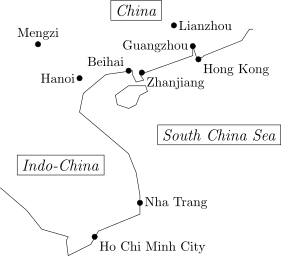
In the late nineteenth century, France had colonies in Southeast Asia (“French Indo-China”). Today, that conquered land would be identified as Vietnam, parts of Cambodia, and parts of Laos. The French government was concerned that it might spread from Guangzhou to nearby Hong Kong (which was under British occupation at the time), and then from Hong Kong to French Indo-China. There was a lot of trade going on between these places, and so, if the bubonic plague really had been a contagious disease, this fear would only make sense. Therefore the French government hired a student of Louis Pasteur to go to Hong Kong and investigate. He arrived at Hong Kong in mid-June of 1894 and his name was Alexandre Émile Yersin.
On the topic of the bubonic plague, Yersin’s writings have been regarded as the most important. He is supposed to be the one who discovered that there was a certain kind of bacterium that caused this disease. His work was so important that this bacterium is now named after him: Yersinia pestis2. Very unfortunately though, Yersin’s most important paper on the topic of the bubonic plague has never been translated into English, at least as far as I’m aware. Therefore, since the bubonic plague occupies such an important place in the germ theory worldview, I’ve gone out of my way to translate from French Yersin’s 1894 paper, whose title translates to The Bubonic Plague in Hong Kong3. With this paper translated, we can carefully examine the methodology used by Yersin in arriving at the conclusion that the bubonic plague is caused by a certain bacterium. Did Yersin really fulfill Koch’s postulates by experimentally showing that this bacterium can induce the symptoms of the bubonic plague?
The first thing to note is that Yersin was coming to study plague with an a priori bias in favor of germ theory. The entire reason Yersin was sent to Hong Kong was because the French government was concerned about the potential for the disease to “spread” from Chinese cities to their nearby colonies. According to Yersin, there was even talk about how it would be impossible to quarantine those large Chinese cities, talk which implies that there was a general belief that the disease was contagious. This is to say that people were concerned that the disease could spread and that it could be stopped by quarantines even before they had evidence of a disease germ. Yersin also noted that the parts of the cities that were hit by the plague had lots of dead rats lying on the ground, and he believed that their dead bodies were a sign of “the very close vicinity of the infectious germs.” On top of this, Yersin himself was a member of the Pasteur Institute, an institution dedicated to blaming diseases on germs. Therefore we really have to make sure that Yersin’s methods make sense. If the only evidence that the plague is caused by a germ is the mere assumption that the plague is caused by a germ, then it obviously wouldn’t make sense to put faith in the belief that the plague is caused by a germ; it would make sense to go looking for a different cause.
The Scottish physician James Alfred Lowson, who was in Hong Kong for the entire duration of the epidemic, described some of the symptoms of plague as follows:
The [appearance] of a plague patient has been variously described by classical writers. Shortly it may be put down as a mixture of anxiety, cyanosis [i.e. skin turning dark bluish-purple] and dyspnœa [i.e. shortness of breath] until the first mentioned is overcome by the nervous symptoms; whilst the character of the gait depends solely on the state of the cerebral system.
Generally speaking there is something indescribable in the face of the plague stricken which seems to help your diagnosis, an expression as if the sufferer himself knew all about it, and his inner consciousness had left his mark on his features.
But the bubonic plague is named for its most recognizable symptom: The appearance of buboes on the body. Today a buboe is recognized as a swollen lymph node. They would typically appear near the groin, in the armpits, sometimes on the neck, and they’d typically grow to about the size of a chicken egg. In addition to humans, the disease was known to attack mice, rats, buffaloes, and pigs.
Yersin found certain microbes in the buboes, saying,
The flesh of the buboes is, in all cases, filled by a veritable purée of a short, stocky bacillus with rounded tips, easy enough to color with the colors of aniline, and is not stained by the method of Gram. ... It is found in very great quantity in all the buboes and the cysts of the sick. The blood sometimes contains it, but in very much less great abundance: it’s only found there in the very serious and rapidly fatal cases.
Having found a bacterium that is present in all sick individuals, the next step would be to isolate that bacterium and perform experiments to see whether introducing it to healthy animals can induce symptoms of the plague. That would be the fulfillment of Koch’s postulates, which would be necessary to prove that the bacterium is the cause of disease rather than merely associated with it; anything short of that would obviously fall short of proving that Yersin’s microbe causes the disease.
Yersin figured out how to culture the bacterium using a mixture of agar, alkaline solution of peptone, and gelatin. But for some reason, his next move wasn’t to purify this bacterium and introduce it to a healthy animal; in a deviation from Koch’s postulates, he instead injected the rotting flesh from a buboe directly into some mice, rats, and guinea pigs. All the animals inoculated this way died within a few days. Particularly noteworthy is that they would have “convulsive seizures” leading up to their deaths, even though seizure wasn’t a symptom of the 1894 plague at Hong Kong4. Therefore, these animal experiments were useless for a couple of reasons: First of all, the isolated microbe wasn’t the independent variable in the experiment, so any disease brought about simply cannot be attributed to the action of a microbe. But even if we look past that, the induced disease wasn’t even recognizable as the plague that was presently ravaging Hong Kong. These experiments killed animals without actually generating any useful information about the plague.
Even though Yersin’s first experiments were useless with respect to germ theory, he actually did go on to use the microbe as the independent variable in some experiments. When he cultured the suspect microbe and then injected it into animals, he found that the bacterium’s “virulence is strangely diminished.” When injected with the microbe, the animals would either live longer (in comparison to when they were injected with rotting buboe flesh) or not even die at all. He also noticed that, if he seeded buboe flesh onto agar in order to grow the microbe, and if he then took that microbe from that first culture and seeded it onto a second plate of agar, and then made a number of passages in this way, “the successive cultures very quickly lose their virulence.” In other words, there’s something in the flesh of buboes that’s capable of inducing some kind of disease when injected, but Yersin proved that it wasn’t the microbe. After a number of passages – i.e. after the rotting buboe flesh is gone but Yersin’s suspect bacterium was still making new generations – the bacterium wasn’t able to cause disease. (Later on, Yersin was actually even able to find the same microbe in the soil. Yersin said, “I have had no difficulty in discovering in the soil of several infected houses a little bacillus identical with regard to aspect and the culture of the plague bacillus. The microbe inoculated into animals does not kill the guinea pig or the mouse—it possesses no virulence.” This is just further evidence that it wasn’t the microbe causing the disease.)
His next experiment was to feed mice and rats the organs of animals that died of the plague. Force-feeding the animals diseased spleen and liver was always able to kill rats and often able to kill mice. Obviously though this doesn’t tell us anything at all about what causes plague. In such experiments, the microbe isn’t used as an independent variable, and so any observed effects can’t just be attributed to a microbe; consumption of diseased organ meat was the independent variable in these experiments, not exposure to a microbe.
In these experiments, Yersin did however note that the mice that were able to survive eating diseased organs would always die after being injected by buboe flesh. This would be strange though if the disease were caused by a germ, and it’s interesting to think about how Yersin must have thought about these experiments.
On the one hand, the fact that feeding diseased organs to rats and mice would usually result in death must have meant that Yersin believed that this was a possible exposure route. Apparently the microbe could attack a host by being consumed. But then not all of the mice died when they consumed the diseased organs. In germ theory, this is usually taken to imply “immunity,” and therefore Yersin probably guessed that these mice would have been “immune.” Nevertheless, when injected with the buboe flesh, they died. At the very least, this proves that the fact that, completely independent of germ theory, the act of injecting buboe flesh can cause an animal to die. Moreover, the results are difficult to interpret in terms of germ theory unless one accepts that the animals dying after consuming diseased organ meats weren’t actually dying because of a microbe, but because of something else. If that were the case, then the germ theorist could argue that the surviving mice didn’t survive because of “immunity” to plague.
Yersin then noted that he was able to find the bacterium “in great abundance” in dead rats he found in the houses and streets of Hong Kong. But since correlation doesn’t prove causation, this doesn’t actually prove anything. We need evidence that those rats had been killed by the microbes. In fact, it would be very surprising if there weren’t microbes breaking down decaying bodies, but for some reason Yersin took the presence of microbes to imply something about germ theory. But since we should expect to find microbes in dead bodies whether or not the germ theory of plague is true, the presence of microbes can’t be used as evidence for the germ theory of plague. When the carcass of an animal is found in the wilderness, it might be surrounded by vultures tearing off pieces of meat, but it would be silly to conclude that it was the vultures that killed the animal; in all probability something was going wrong long before the vultures showed up. But as silly as it would be to see vultures on a dead animal and assert that they were responsible for killing it, that’s essentially what Yersin did: He found some microbes in some dead animals and asserted without evidence that they caused the death. What Yersin did was only therefore equally as silly, since up to that point there was not evidence that the plague was caused by a germ; after all, he was supposed to be the one to figure out if it was.
Next he described an experiment involving keeping some mice in one container and inoculating some of them. He didn’t actually describe whether he inoculated them with the microbe or with the flesh of a buboe, but, since he found that the microbe alone wasn’t virulent, he probably inoculated those mice with buboe flesh. He didn’t describe anything else about this experiment either, such as the conditions that the mice were kept in or what the mice were fed, so already we have to be a little suspicious. His observed result was that all of the inoculated mice died first, and that the non-inoculated mice died later on. Well he already knew that inoculated rodents would die, so it’s not that surprising that the inoculated ones would die first and the non-inoculated ones later on. Plus, since he didn’t even say if he was feeding them, he might have even left the non-inoculated mice to cannibalize the dead mice, which he already showed was capable of causing the mice to die. Nevertheless, he believed that this poorly documented experiment proved that,
The plague is therefore a contagious and inoculable disease. It is probable that rats constitute the principal vector, but I have equally observed that flies catch the disease, die from it, and can thereby become agents of transmission.
This statement by Yersin kicked off the superstition that rats were harbingers of plague. Today it’s recognized that this belief is inconsistent with historical records. Most notably, the plague sprang up twice in fiftheenth century Iceland despite the fact that at that point rats hadn’t yet been introduced to Iceland. Nevertheless it’s Yersin’s lingering influence that this myth about rats continues perpetuating even today.
It’s also interesting that Yersin could claim that flies can “catch” plague and die from it, given that flies have extremely different anatomy from humans and rodents. Has anyone ever seen a swollen lymph node on a fly? How about cyanosis or the petechial spots? Did Yersin see the flies’ skins turn bluish-purple? Because apparently those are the things that Yersin was claiming. Moreover, even if flies die and are found to have a certain kind of bacterium in them, again, it would be silly to assert without any evidence that the bacteria caused their death; that would have to be verified by actual experiments rather than by Yersin’s observations about seeing a lot of dead flies in his laboratory: Does introducing the microbe to a fly cause the fly to die? Yersin never even tested this, and only assumed what he wanted to believe anyway.
In any case, believing that flies could carry the still purely hypothetical plague germs, Yersin pulled the legs, wings, and head off of a fly, ground its body up, and put it into a “stock.” He didn’t actually describe the stock at this point, but it could be inferred from something he said earlier that the “stock” consisted of his mixture of agar, alkaline solution of peptone, gelatin, and buboe flesh. So when Yersin ground up a fly, added it to some complicated mixture, inoculated a guinea pig with it, and then the guinea pig died, that didn’t really prove anything useful. Again, the microbe simply wasn’t the independent variable; the independent variable would have been the messy concoction consisting of everything in Yersin’s “stock” along with the ground fly. But on top of being poorly documented, Yersin also didn’t even perform a control for this experiment, i.e. he didn’t inject a guinea pig with this stock without the ground up fly added to it. This is important because he’d already shown that injecting buboe flesh into an animal is capable of causing it to die, so obviously a mixture containing buboe flesh – whether or not it contains a ground up fly – would likely cause his guinea pigs to die. Therefore it doesn’t seem that this experiment actually proved anything useful. He proved that injecting that strange mixture into a guinea pig can cause it do die, but he didn’t show that exposing a guinea pig to a microbe by itself is capable of causing the guinea pig to come down with the plague, or even that there was something in the fly that caused the guinea pig to die. That concoction could hypothetically have a plague disease-germ in it, but Yersin certainly didn’t prove that; he only assumed it.
So despite that this was the most important paper ever written on the subject of the plague, Yersin didn’t manage to prove that the plague was caused by a germ. Worse than that, any unbiased observer would have to conclude that he actually even managed to prove that the microbe he found does not cause the plague. If he passaged the microbe a few times, its virulence was “strangely diminished,” and then when he found the “identical” microbe in some soil, he said that the microbe simply had “no virulence.” So obviously, whatever was causing plague, it couldn’t have been that microbe. That microbe was at the scene of the crime, sure, but its innocence has been proven, and by Yersin himself. Its guilt was only ever assumed from the beginning, and in a way that would make Kafka blush.
The reader might be wondering: “If Yersin plainly showed that his microbes don’t cause disease, then how did he reconcile that to his claims that they did cause disease?”
The answer is by making things up, new epicycles to place on old ones, piling more theory on top of the original model to reconcile with the experimental failures: For whatever reason, some of Yersin’s germs weren’t really germs. Some portion of them, he asserted, didn’t cause disease. And then when he passaged the microbes from one sample of agar to the next, he assumed that the reason for the rapid loss of virulence was because, for some completely unexplained reason, it must have been the non-virulent microbes that reproduced faster, so as to outnumber the virulent ones by an exponentially growing margin after just a small number of generations.
This is an interesting set of hypotheses, but it must be admitted that it’s just that: a set of hypotheses. Worse than that, they even seem like something invented for the sole purpose of preventing the germ hypothesis from being falsified. Did Yersin have any evidence that there were two completely identical kinds of microbes, the one virulent and the other non-virulent? No, he didn’t; he merely assumed it. Further, did Yersin have any evidence that the non-virulent microbes reproduced faster than the (still purely hypothetical) virulent microbes? Absolutely not. Again, he only assumed it. His “proof” was the fact that the microbe lost its virulence after a small number of passages. So the simple interpretation of the evidence would indicate that those microbes weren’t actually disease-causing, but then Yersin merely generated additional ad hoc assumptions to protect his a priori belief in germs from having to make hard contact with reality. Evidence had nothing to do with it. Worse, the evidence was a hindrance that Yersin had to explain away.
So the entirety of the case for the germ theory of the plague was rested on some untested assumptions. But, even worse than that, these additional assumptions make the germ theory of plague hypothetically untestable: If it’s the case that isolated microbes are never found to cause disease, a germ-believer can always just assert that the culturing process used was a faulty one, and that for some reason it favored the generation of non-disease-causing microbes at the expense of the (still purely hypothetical) disease-causing ones. No matter how many times the germ theorists’ own experiments fail to bear their expected results, they will always be able to just assert that there must have been a problem with finding their plague germ, because they just “know” that it exists. But this can’t be called a scientific pursuit of Truth; this is religious zealotry on full display: The germ-believer “knows” that the plague is caused by a germ before he carries out any experiments, and he’s not about to let experimental results dissuade him from what he “knows” to be the case. This actually makes the germ theory of plague unfalsifiable since any falsification can always be batted away by the germ theorists making up new excuses as to why their experiments don’t go as predicted. Moreover, very importantly, the germ theorists can even make up excuses that put their claims beyond the reach of experiment. For those who care about falsifiability, this should be very disturbing.
Moreover, Yersin’s epicycles only raise further questions: If it’s the case that, both in the laboratory as well as in the soil, we’re only able to find and cultivate non-disease causing microbes, then what could have possibly led to the situation where the (still purely hypothetical) disease-causing microbes came to such great abundance that they not only caused one or two people to get sick, but that they caused widespread disease all over the cities of southern China? This wimpy little (puely hypothetical) microbe can’t last even a few generations because it’s not as fit as its non-disease-causing twin, but for some reason the laws of nature were reversed apparently all over Hong Kong with the sole exception of in Yersin’s laboratory. Does that sound plausible?
The reader might be thinking, “Ah, but what if the purely hyothetical disease-causing microbes really do exist, and that they simply thrive in different conditions than what the non-disease-causing microbes thrive in. Maybe that could explain why it affected certain portions of the world and apparently didn’t spread elsewhere.”
But if we say that there must be certain conditions that allow for the (still purely hypothetical) disease-causing microbes to out-compete their actually-proven-to-exist counterparts, then we have to be sure that it’s really the microbes and not merely those conditions per se that lead to disease. For example, if exposure to dead animals and excrement is found to cause plague, then, in order to be confident that the germ theory of plague is true, we would have to be able to show that exposure to dead animals and excrement per se does not cause disease, and it’s just that these animals allow for the (still purely hypothetical) disease-causing microbes to flourish. Filth without the microbe shouldn’t induce plague, and the microbe without the filth should induce plague. That is the claim that the germ theory of plague is tasked with defending. The only problem is that there’s no indication that this is the case, and it’s certainly plausible that being around dead animals and excrement can cause disease by itself completely regardless of what microbes there are breaking down the dead animals and excrement.
There’s also the problem of European resistance. Yersin mentioned that plague had long existed in Persia, Arabia, and Yunnan. But if it’s a contagious disease, then there’s no reason for it to stay circumscribed to these places. It should spread, but it doesn’t, which is certainly suggestive of the fact that there could be something common to these three places that’s plague-inducing that has nothing to do with invisibly small creatures. Basic epidemiology would suggest that the people living in these places are exposed to some common cause of disease that doesn’t exist elsewhere. Moreover, it happened to be a fact that the European population of Hong Kong was rarely affected by the plague, despite obvious contact with the conquered Chinese population.
Today, people can assert that it doesn’t spread because the people from certain places are “immune,” but that would just be yet another unproven assumption invented for the sole purpose of preventing falsification. And it runs into its own problems: There has been trade between Europe and Asia for thousands of years along the silk road. Are we to believe that the Europeans gained some supernatural “immunity” to the plague, but the Asians didn’t? All that contact over the centuries, but there’s just something magical about Europeans? It seems pretty clear that the only reason Asians weren’t granted “immunity” to plague was because otherwise the germ theory couldn’t make sense of the plague at Hong Kong, and we all “know” that it must make sense of the plague; to a germ theorist, a germ is the only acceptable answer as to what caused the plague at Hong Kong.
Yersin himself didn’t attribute the European resistance to some kind of epicyclic “immunity,” but rather to the “much better hygiene” that the Europeans had. Of course, this observation by Yersin invites the hypothesis that poor hygiene per se might be a cause of plague, rather than some harmless microbe that can be found even in the soil. Filth itself could be the cause of disease rather than microbes found in the filth. This possibility was never ruled out, and is even consistent with Yersin’s experimental results.
But while the microbe was never proven to be the problem, filth itself was a major problem in Hong Kong. According to Lowson,
In 1887 an Ordinance entitled The Public Health Ordinance was passed which handed over the sanitary control of the Colony to a semi-representative body called the Sanitary Board. Much of the work so delegated to it has been carried out in an efficient manner. The external scavenging of the streets leaves little to be desired, and many efforts have been made to encourage and foster a higher standard of cleanliness amongst the native population. Unfortunately the Chinaman resents strongly any attempts to interfere with his domestic privacy, and a little too much deference has probably been shewn to his prejudices in this respect. In any case it must be admitted that the interior of the native houses was such as may fairly be described as a disgrace to a civilized community.
Lowson reported that, “The fæces were also suspected as an additional mode of conveyance of infection,” also going on to say that, “the fæces were always looked upon as the most prolific source of infection,” and even that, “if proper sanitary precautions are taken, no civilised country should ever be the seat of an epidemic of plague.”5 But why did the feces have to contain plague germs? Why couldn’t it simply be that exposure to feces per se can cause plague? And why were they so certain that there was a plague-causing microbe before they had any evidence for that position?
In fact, Yersin’s paper even pointed to a probable source of the plague-inducing filth:
It is interesting to note that, in the part of the city where the epidemic first exploded and caused the most devastation, a new sewer canal came to be installed. The conduits, with dimensions much too cramped, are separated by distance upon distance from the sedimentation basins whose cleaning is pretty much impossible and which constitute, as a result, multiple permanent sources of infection. It’s not understood why there exist in Hong Kong two distinct sewers: the one large and well conditioned, for draining rain water; the other, constantly obstructed, for the cleaning waters and the waste from the houses.
The bathrooms of the wealthy are made up of mobile chamber pots that are changed every day and whose contents, after having undergone certain preparation, serve to fertilize the innumerable Chinese gardens which border the Pearl River, across from the island of Hong Kong.
The apartments, occupied by the Chinese of the lower classes, are everywhere disgusting slums where one hardly dares to enter and where there’s gathered an incredible number of people. Many of those slums don’t even have windows and are below ground level. One grasps the ravages that an epidemic can cause when it takes residence in such terrain, and the difficulty that one must have in trying to stop it! The sole remedy has been setting fire to the Chinese city: it has been proposed, but some budgetary reasons have delayed it from being followed.
So there was a new sewer system installed in Hong Kong that wasn’t able to adequately move the waste. The conduits were far too long and narrow, and so would become clogged, so the poor people were living in their own excrement. This didn’t affect the wealthier people, whose bathrooms contained mobile chamber pots. This alone might explain why the Chinese had a death-rate of 93.4 percent, whereas the Europeans only had a death rate of 18.2 percent. And then despite that Yersin understood the problem with the Hong Kong sewage system, instead of advocating for better waste management he favored burning down the homes of the poor6.
But all this also offers a clue as to the true cause of plague. In fact, there might even be a microcosm-macrocosm analogy to be made here between the human body and the city of Hong Kong. Nutrition is taken from the digestive system and, using the circulatory system, distributed throughout the body. But the cells throughout the body are not only consuming nutrition but also producing waste. In order that waste not build up all over the body, the waste is taken away using the lymphatic system. Therefore the lymphatic system itself could be thought of as something like the sewer system of the body. So when Hong Kong’s sewage system was clogged up, that allowed people to come into far more contact with waste, excrement, the rotting corpses of animals, thing like that. The constant contact with filth then caused a build up of waste in the body, even to the extent that the body’s sewage system was getting clogged too. The clogging of the lymph nodes resulted in them swelling up, which is just what we call buboes. And so a clogging of the waste management system of Hong Kong resulted in a clogging of the waste management system of the human and animal bodies that inhabited Hong Kong.
This also makes sense of Yersin’s experiments: Because of what the lymphatic system is, flesh from a buboe consists partly of waste materials, and so injecting those waste materials into a living animal is a way to clog up that animal’s lymphatic system too, resulting in its own plague. This isn’t because plague is contagious, but because plague is the clogging of the lymphatic system.
And, of course, since Yersin showed that the microbes found in lymph nodes didn’t cause disease, we have to wonder what they were actually doing there. Could they have been serving a neutral or even beneficial role? On the one hand, these microbes were found in dead animals and soil, so it’s completely plausible that they merely break down organic matter: Maybe they just thrive in filth, and the lymphatic systems of plague victims were full of filth. On the other hand, we even have to wonder if Yersin’s microbes might have been serving a noble cause: In the same way that each of our guts is teeming with microbes that help us to digest our food, it’s plausible that the body could enlist this filth-loving bacterium to help clean up the lymphatic system when it gets clogged up. Apparently neither of these hypotheses was even considered by Yersin, even though both are immediately more plausible than the one he ended up defending.
We also have to consider the role of drugs in the epidemic. In the mid-nineteenth century, opium addiction was a major problem in China, especially as a result of British imperialism. As the number of opium addicts climbed, the Qing government attempted to outlaw the sale of opium. Because the British elite made a lot of money shipping opium from India to China, the ban on opium kicked off the Opium Wars as British merchants wanted to continue moving the drug. Britain won the Opium Wars, and so it was able to continue selling the drug to China, against the will of the Chinese government, resulting in a substantial segment of the Chinese population being dependent on the substance. One can only wonder if there might be a connection between the widespread drug addiction and the filth that would create the perfect conditions for the plague—after all, drug addicts aren’t known for good hygiene. Therefore this might not have been so much a deficiency of Chinese culture as much as the expected result of a nation being wrecked by decades of imperialism and drug addiction. The century immediately following its defeat in the Opium Wars is considered to be China’s “century of humiliation.”
But, having gone over the evidence that was put forward for the existence of a plague germ, and having gone over what the more likely cause of plague is, let’s turn our attention to the handling of the epidemic at Hong Kong. In fact, a contemporary Japanese bacteriologist named Kitasato Shibasaburō made the same finding as Yersin did, and at the same time that Yersin did. When the two of them started running around Hong Kong claiming that they found a microbe in the lymphatic fluid of plague patients, and therefore implied that this microbe was the cause of plague, identification of the microbe in a patient’s fluids became the diagnosis. No longer was plague identified by its symptoms, but by a microbe that hadn’t even been shown to cause symptoms of plague. On the topic of culturing bacteria in order to make diagnoses, Lowson said,
The bacilli are often few and far between, but it is of the utmost importance that a careful examination be made in cases where no glandular swelling can be felt and where the diagnosis is doubtful. During the latter part of the epidemic about 80% of the cases were diagnosed by the microscope alone, involving many hours’ labour a day on what to most people is not interesting work. Once the bacillus is found the case is one of plague.
Lowson also listed a number of treatments that patients were put through. First off, they were all stripped naked and their clothes “were burned on admission.” This was because of the fear that the clothes might contain the microbe, even though Yersin showed that that the microbe was harmless. Pretty much everything in the hospital was sanitized using eucalyptus oil, carbolic acid, potassium permanganate, and a disinfectant known as Jeyes’ fluid. People took baths in water containing Jeyes’ fluid.
The first drug prescribed to plague victims was calomel, “the usual purgative to commence with,” with the word “purgative” being a term for substances that induce bowel movements. Calomel, also known as mercurous chloride, is a mercury-containing mineral that has historically been used as a purgative. The reason that the mineral acted as a purgative, obviously, was because as soon as the gastrointestinal tract recognized that its contents contained mercury, the gastrointestinal tract would try to get everything out as swiftly as possibly in order to avoid absorbing that mercury. A 10 grain dose (about 0.65 grams) of calomel was given to each patient to start. Sometimes this was combined with another purgative, such as jalap powder, which is a powder derived from the dried tubers of the Ipomoea purga plant7. Calomel usually doesn’t induce vomiting and even prevents it, but in cases where calomel was given and vomiting persisted, the patients would also be given hydrocyanic acid mixed with morphine. The former is a toxic chemical related to cyanide, while the latter is an addictive pain-killer.
Lowson advised against giving calomel to too many new patients at once, since it would make a mess of their bedding:
Mattresses, pillows and mats were burned after being in use some time, the length of time in use depending on the amount of soiling. If we had a more ample supply of mackintosh sheeting, a large one would have been put on each bed, as being by far the best way of keeping beds in a sanitary condition. One thing to be beware of is not to give purgative medicine to all new patients at the same time. Often when a number of patients had calomel after the evening rounds the nurses had a rather hard time of it the following morning, which delayed the routine work of the hospitals too much.
It should also be noted that calomel wasn’t the only source of mercury: The Alice Branch Memorial Hospital also experimented with injecting the buboes directly with mercury iodide. According to Lowson, this treatment assisted in killing patients.
We can only wonder how much worse the disease was made by the European physicians who were handing out doses of mercury – a substance known to induce bowel movements – in a city that has a dysfunctional sewage system and for a disease caused by exposure to filth. And, of course, the excrement of any patients treated with calomel would be laced with mercury, so on top of there being filth everywhere, the filth in and around the hospitals would contain mercury too. Is it any wonder that Yersin remarked that the mortality was 95 percent in the vicinity of hospitals?
Other medicines given included ammonia, a toxic substance; tincture of cinchona, which is derived from the bark of a certain tree and contains quinine; and chloroform water, an anaesthetic. These three were given to a patient once every four hours if the patient had an irregular heartbeat. They also prescribed the herbs digitalis, strophanthus, and strychnia. Strophanthus has historically been used to prevent heart disease. Various drugs were used in an attempt to bring down the fever. Morphine, hyoscine, potassium chloride, or potassium bromide were used to induce sleep in patients. All of these can be toxic. Hyoscine, also known as devil’s breath, is a psychoactive substance, also known as a deliriant, meaning that it can be used to induce hallucinations. It’s perhaps worth noting that this means we have to wonder if delirium was a symptom of plague, as both Yersin and Lowson claimed, or simply an effect of the medicines given to plague victims. High levels of potassium, known as hyperkalemia, can cause the heart to stop8. Sometimes the physicians would give patients opium enemas, or even give them suppositories made of a quarter of a gram of morphine and a half gram of cocaine. They also handed out glycerine, belladonna, iodine, senega, camphor. They also tried catheterization and giving patients oxygen.
And we can only have sympathy for the Chinese people who had the misfortune of having to deal with the European physicians handing out toxic substances. Lowson criticized the Chinese for their fear of European medicine:
The terrors of the disease itself were rendered greater by the fear the poor wretches often had of falling into the hands of “foreign doctors.” It is no great credit to our boasted civilisation or to our vaunted mission work that the average intelligent Chinaman of to-day prefers the fetish tricks of the native practitioner to the more enlightened methods of graduates of the western schools; but the fact remains that the horror of western medicine is by no means confined to, though almost universal among, the members of the coolie class9. So evident was this fact that it was deemed prudent to allow such sufferers as preferred their own native doctors to be attended by them, in hospitals under European supervision.
Pretty pompous for a guy peddling mercury. Lowson even called the Chinese ignorant for not just going along with those “more enlightened” European physicians.
This is all highly ironic given that Lowson nevertheless confessed that there was good reason for the Chinese to be suspicious:
I must confess that many cases were not benefitted by some of the drugs used – drugs which are so often given with impunity in other serious diseases – and in making this statement I am criticizing my own as well as my colleagues’ treatment. The reason why we did not find out this almost at the beginning of the outbreak was that we had no time to watch the immediate effect of our treatment as there was so much to do, and in many cases which we had marked to watch carefully the patient had succumbed before the next visit was paid.
On the one hand he wants to paint the Chinese as ignorant for not just putting religious faith in the European physicians who only just showed up and certainly hadn’t proven themselves (not to mention that it was only decades earlier that Europeans declared war on the Chinese for the right to be able to sell opium, which is just another reason for it to be reasonable for the Chinese not to trust the Europeans), but then on the other hand he admits that the European physicians – himself included – didn’t know what they were doing, and that many cases weren’t benefitted by the drugs used. The European physicians worked by trial an error, prescribing things and then waiting to see the effects, but there was no reason that the Chinese couldn’t have done their own experiments. After all, at that point all treatment was really just guesswork. Worse, in treating this filth disease, the Europeans prescribed purgatives, resulting in widespread filth. Lowson had zero self-awareness.
(Moreover, it was a major problem for pharmaceutical companies that the Chinese people didn’t trust European quack medicine. This problem would be remedied two decades later when, in the year 1914, the Rockefeller Foundation established the China Medical Board for the purpose of increasing Chinese trust in European medicine. Even though “China” is in its name, today the China Medical Board actually supports and influences 118 medical schools in 17 different countries throughout Asia. Only 28 of the medical schools under the influence of Rockefeller’s China Medical Board are actually in China.)
But the treatments apparently weren’t all bad. Perhaps the most important part of the treatment regiment was the fresh air and the nutrition. Lowson even said, “Plenty of fresh air was a sine non qua,” implying that patients simply wouldn’t get better unless they had access to fresh air10. Patients were also provided with eggnog and strong beef broth, both of which contained brandy. Lowson also said that beer, stout, and ice cream made with pure cream had beneficial effects on the patients. He considered all these to be very nutritious.
The following year, Yersin founded his own Pasteur Institute in the city of Nha Trang along the Vietnamese coast, and at this institute he carried out research towards a plague vaccine. Because he repeatedly found the microbes to be non-virulent, he was hopeful that they would be able to give people “immunity” without causing disease. In 2000, the Cochrane Collaboration wanted to do a review of all of the literature on plague vaccines, but, to their surprise, there were exactly zero trials published that studied the efficacy of plague vaccines. In other words, more than a century later, there is simply no evidence that plague vaccines prevent plague. This makes sense, since this microbe that everyone imagines causing plague has actually never been shown to cause plague.
So in summary, Pasteur’s student Alexandre Yersin arrived at Hong Kong with the a priori conviction that the plague was caused by a germ. Yersin conducted experiments and the results plainly pointed against germ theory, but he nevertheless clung to his belief, his faith never wavering. The more obvious cause of plague, namely filth per se and not the invisibly small creatures breaking down the filth, was not even considered as a possible cause. The fact that Hong Kong had an inadequate waste management system didn’t make an impression on him. The assumed role that Yersin’s microbes played in the swollen lymph nodes was never questioned; he simply “knew” that they were germs, despite the fact that experimentally they didn’t cause disease. The presence of these microbes, therefore, was even used in the diagnosis of plague, despite that inconvenient fact that they didn’t induce disease. Since the microbe was found in dead rats, it came to be believed that rats have something to do with “spreading” plague, even though the disease didn’t actually spread. This is still believed today, even though it can’t make sense of the historical record. And, of course, the nineteenth century physicians poisoned their patients with things like mercury and opium, as usual. Beyond just being a toxic metal, the use of mercury was particularly harmful since it induces bowell movements, leading to the hospitals being filthy places—perfect for people who are diseased because of exposure to filth.
Lanzhou is not to be confused with Lianzhou. Only the latter can be found on the map provided; the former is too far north.↩︎
The “pestis” part of “Y. pestis” is actually just the Latin word for plague. Yersin, writing in French, used the word peste in referring to the disease, a French word which is a direct descendant of that Latin word.↩︎
My translation can be read and downloaded for free at https://forbidden-knowledge.com/reference_docs/1894-yersin-the-bubonic-plague-in-hong-kong.pdf.↩︎
In Yersin’s paper, he gave a list of symptoms of the plague, and convulsive seizures were not on that list. Moreover, the word “seizure” appears nowhere in James Lowson’s 1895 book The Epidemic of Bubonic Plague in 1894.↩︎
The reader might remember from my blogpost Smallpox and Vaccination that this is exactly what, five years later, Alfred Russel Wallace would go on to say about the plague: It was simply a “filth disease.” Wallace said,
The most terrible and fatal of these [filth diseases]—the plague—prevails only where people live under the very worst sanitary conditions as regards ventilation, water supply, and general cleanliness.
Wallace also said, “if the whole population of a country lived under thoroughly healthy conditions as regards pure air, pure water, and wholesome food, none of [the filth diseases] could ever obtain a footing.”↩︎
In the quoted text, it’s ambiguous whether or not Yersin was personally in favor of cleansing the city by fire, but Lowson recorded that it was Yersin’s opinion that the homes of plague victims “should be destroyed, preferably by fire.”↩︎
On the topic of jalap powder, one modern writer has said that, “because of its strong purgative properties, it is essential to prepare and consume this powder safely to avoid adverse effects.” This writer goes on to say that it works as a purgative “by irritating the intestinal walls,” and that it can cause “dehydration, cramping, or more severe side effects.”↩︎
It’s interesting to note that potassium chloride is often used today as a substitute for table salt, called sodium chloride. This is because a lot of people have been terrorized into thinking that sodium is basically poisonous by increasing blood pressure and presumably causing heart attacks. It’s therefore very ironic that people intentionally consume potassium chloride instead, which is a substance believed to be capable of stopping the heartbeat.↩︎
[The term “coolie” is an archaic term for a wage-laborer, especially of Chinese or Indian descent.]↩︎
“Fresh air” meant access to outdoor air and open windows; it didn’t have to do with smoking though. Some patients complained that the smoke from pipes and cigars was making them nauseous, but Lowson claimed that they figured out how to remedy this. In his words, “Free smoking should be allowed,” although he also said that, “If smoking goes on then a carbolic mouth-wash should also be insisted on.”↩︎

Comments
Add a Comment
In order to encourage discussion, comments may be made anonymously without creating an account. However, due to the serious nature of the disscussions that take place on Forbidden Knowledge, all users who make comments require a unique pseudonym. There are two reasons for this. First, it makes it possible to identify comments made by the same person. Second, it prevents users from impersonating each other. We encourage users who plan on making more than one comment to first make an account. However, if you choose to make a comment without making an account, the system will generate a generic pseudonym for you and save a cookie to your device so you can be recognized in the future. If the cookie is deleted from your device, that identity will be lost, and if you make another comment the system will generate a new generic pseudonym for you.
Users who intend on making multiple comments are encouraged to create an account. Creating an account allows you to select your own pseudonym and securely persist it without relying solely on cookies. Account creation is simple and requires only a password and an email address. The email address is strictly only used for password resets. We do not share user information with anyone. We do not record the IP addresses used with a particular account. We are not interested in knowing who users are in real life. User accounts are only in place so that comments can be identifiable.
If you decide to make an account after making comments with a generic, system-provided pseudonym, your existing comments will automatically update to appear with your new pseudonym.
You are not logged in. Choose one of the options below to comment: